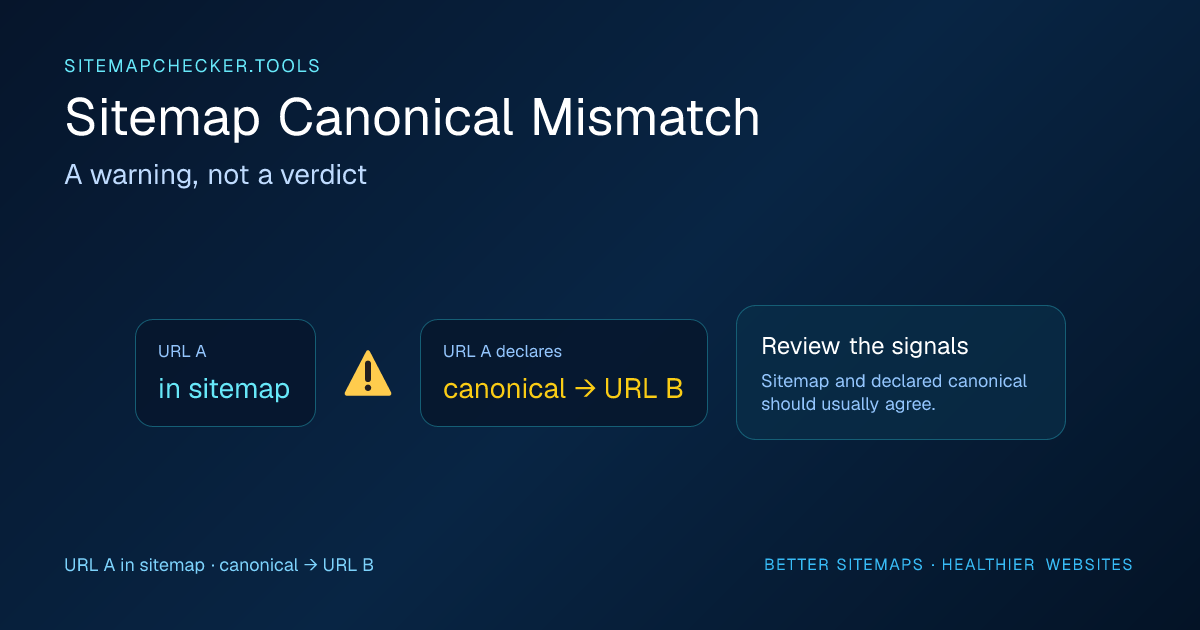
A sitemap canonical mismatch happens when a URL listed in an XML sitemap loads successfully but declares a different URL in its rel="canonical" annotation.
For example, the sitemap lists:
https://example.com/product?color=blue
but the page declares:
https://example.com/product
as canonical.
That is not automatically an indexing failure. Google describes canonical annotations, redirects, HTTPS, and sitemap inclusion as signals used during canonicalization, and Google can ultimately choose a different canonical from the one you prefer. But when the sitemap and page-level canonical disagree, your own technical signals are not aligned.
Use the Sitemap URL Checker to find sampled sitemap URLs whose declared canonical points somewhere else.
Why sitemap inclusion is a canonical signal
Google's sitemap documentation says a sitemap should contain the canonical URLs you want to see in search results. Its canonicalization documentation also lists presence in a sitemap as one of the signals used when selecting a canonical URL.
That means a clean setup usually looks like this:
- sitemap lists URL A;
- URL A returns a successful response;
- URL A's canonical points to URL A, or there is no conflicting canonical signal;
- internal links primarily point to URL A;
- duplicate alternatives consolidate toward URL A.
When the sitemap lists A but A declares B as canonical, the site is effectively saying both “A is preferred” and “B is preferred.”
A canonical mismatch is a warning, not a verdict
This distinction matters.
Google explicitly says canonical preferences are signals rather than absolute rules. Even a self-referencing canonical does not guarantee Google will choose that exact URL, and a different canonical does not by itself prove the source URL can never appear in search.
For that reason, SitemapChecker.tools reports a different canonical as a canonical signal conflict rather than labeling the URL categorically “not indexable.”
The correct next step is to determine which URL should actually be canonical.
Common reasons for canonical mismatches
Parameter and filter URLs
A faceted ecommerce URL such as:
/shoes?size=9&color=black
may canonicalize to /shoes. If parameter URLs are intentionally duplicates, they usually do not need to be listed individually in the sitemap.
HTTP and HTTPS leftovers
A sitemap may still contain HTTP URLs after a migration while pages redirect or canonicalize to HTTPS.
Update the sitemap generator so it emits the preferred HTTPS URLs directly.
www and non-www variants
A sitemap generated under one hostname can conflict with sitewide canonicals pointing to another hostname. Standardize the preferred host across sitemap entries, redirects, canonicals, and internal links.
Trailing-slash inconsistencies
/page and /page/ can be distinct URLs at the protocol level. If one version redirects or canonicalizes to the other, list the preferred final version in the sitemap.
CMS or plugin template errors
Canonical tags are frequently generated automatically. A template bug can cause every paginated page, category, product variant, or localized page to point to a broader parent URL.
If many sitemap URLs show the same unexpected canonical destination, investigate the template rather than editing individual sitemap entries.
Migration leftovers
After a site move, the sitemap may have been updated while canonical tags still point to the old domain, or vice versa. This creates a strong cross-site inconsistency that should be fixed promptly.
How to decide which URL belongs in the sitemap
Do not blindly change the canonical to match the sitemap. First decide which URL is the actual preferred page.
Ask:
- Which URL should users land on from search?
- Which version contains the primary content?
- Which URL do internal links use?
- Which URL receives redirects from duplicates?
- Which URL should accumulate ranking and reporting signals?
- Is the alternate URL genuinely duplicate or near-duplicate content?
Once the preferred URL is clear, align the sitemap and canonical signals around it.
How to fix a mismatch
If the canonical destination is correct
Suppose URL A is in the sitemap but correctly canonicalizes to B.
Then the clean fix is normally:
- remove A from the sitemap;
- add B if it is not already present;
- point important internal links to B;
- keep A's canonical to B if A must remain accessible;
- consider a redirect if A does not need to remain a separate user-facing URL.
If the sitemap URL is correct
If A is the page you truly want indexed but the canonical points to B by mistake:
- fix the canonical template or page setting;
- confirm A returns a successful response;
- confirm A is not noindex;
- make important internal links point to A;
- re-run the URL audit.
Missing canonical is not automatically a sitemap error
A page without an explicit rel="canonical" is not automatically invalid or non-indexable. Google can choose canonicals without a canonical tag based on other signals.
That is why the checker shows Not declared for a missing canonical but does not count that alone as a canonical conflict.
The stronger warning is a canonical that exists and points somewhere different from the fetched final page.
Redirect plus canonical mismatch
A particularly noisy configuration is:
Sitemap URL A → redirects to B → B canonicalizes to C
Now the sitemap, redirect, and canonical all point in different directions.
Simplify it:
- decide whether C is truly the preferred page;
- if yes, list C in the sitemap;
- redirect legacy URLs directly to C where appropriate;
- make C's page-level signals consistent.
Verify with Google when the stakes are high
A third-party checker can read the canonical declared in the live HTML response. It cannot tell you which canonical Google has actually selected for a specific page.
For that, use Search Console URL Inspection and compare User-declared canonical with Google-selected canonical.
The checker is best used to find technical inconsistencies at scale before you move into Google-specific diagnosis.
Final rule
Your sitemap should be a clean list of preferred URLs, not a collection of every accessible duplicate. A different canonical is not proof of failure, but it is a strong reason to review whether the sitemap is listing the right version of the page.